Abstract:
When the load or pressure is less than or equal to the elastic limit of any material, the material returns to its original shape. The purpose of this blog is to talk about the physics principle, “Hooke’s Law,” which defines the relationship between the force applied and the deformation of the material. The spring constant, which can be used to explain the relationship between the deformation and force applied, can be found by conducting a Hooke’s Law experiment. According to Law, it can be assumed that the higher the spring constant, the lower the elasticity of the material.
“Ut Tensio, Sic Vis”
“As the Tension, so the Force” – Robert Hooke – 1678
What is Hooke’s Law?
Hooke’s Law, also known as the Law of Elasticity, states that deformations of a material or object, are always directly proportional to the displacement of the deformation due to the force or load causing the change in shape. If the force/load is relatively small, the object can return to its original shape once the load has been removed.
By Dhruv Mistry | 30892503
Academic Integrity Declaration:
“I am aware of the requirements of good academic practice and the potential penalties for any breaches.”

Illustration of Robert Hooke at Oxford University by Rita Greer
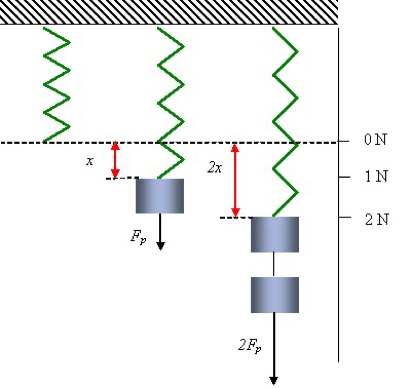
Illustration showing that the force is always linearly related to the extension of a spring.
What is Hooke’s Law? (Cont.)
The elastic behaviours within solids, according to Hooke’s Law, state that tiny displacements from the standard positions deform the atoms and molecules. These displacements can also be assumed to be proportional to the force which caused the deformation. The deformation of the object can take place by stretching, compressing, twisting and many other forms. With this in mind, a metal wire exhibits elastic behaviour according to Hooke’s Law because when an applied force extends it, the small increase in its length doubles each time the force is doubled as shown in Image 1. Mathematically, Hooke’s Law states that the force F applied is equal to a constant k multiplied by the displacement or length change x, or more simply known as F = kx.
The value of k depends not only on the type of elastic material being considered but also on its size and shape.
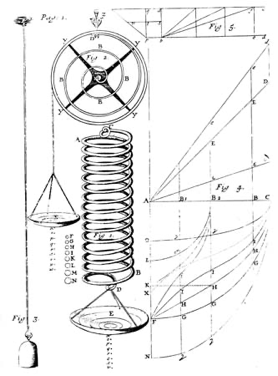
Illustration from Robert Hooke’s Lectures de Potentia Restitutiva (1678) of Hooke’s law of material elasticity,demonstrating thestretching of the spring when a force is applied.
From Image 3, it is determinable that the proportionality between the equation, F = kx shows that when the mass doubles, the displacement length also doubles proportionally. Sometimes the equation can be found to have a negative sign before the k (spring constant), and this is because the restoring force to bring the object back to its ‘normal’ dimensions needs an equal and opposite force to the force which caused the deformation in the first place.
The Experiment Explained:
To test the physical formulas of Hooke’s Law and see how the deformation takes place with real-world materials, we gathered results from an experiment.
We analysed them, testing the theories of Hooke’s Law.
Within the experiment, there were three different materials explored when testing their elastic limits and measurements of deformation. The three materials throughout the following of this blog are called:
– Material 1, Y1
– Material 2, Y2
– Material 3, Z
Results and Graphs, Y1 and Y2:
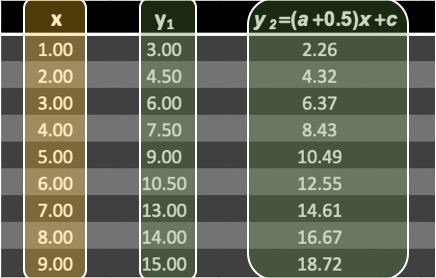
The data given are x (force applied in Newtons) and y1 and y2 (deformation in mm).
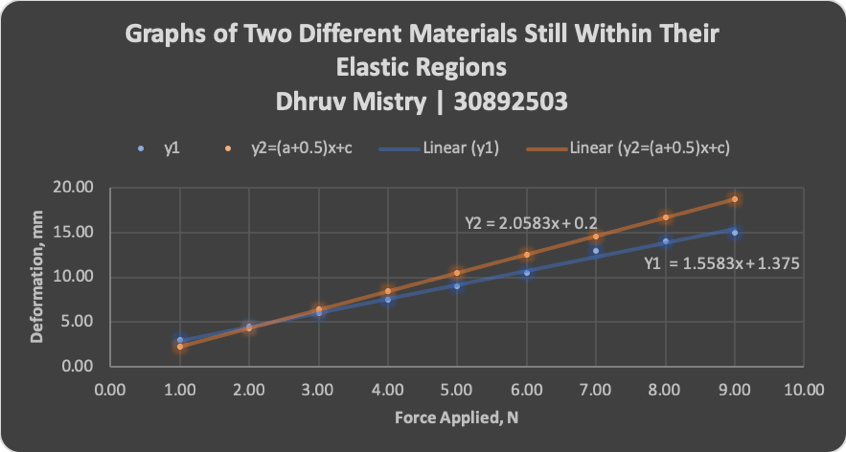
A Graph of Two Different Materials Still Within Their Elastic Regions
Analysis of Materials Y1 and Y2:
As shown above, in Graph 1, there is a directly proportional relationship between the force applied and the deformation for both materials, Y1 and Y2. When the ‘Force Applied, N’ was increased, the ‘Deformation, mm” increased proportionally on both materials, Y1 and Y2. Therefore, this proves for these two materials that Hooke’s Law is, in fact, true for the forces which the materials were experimented with. When we look at these two graphs a little more closely however, we can see that the slopes to the linear equations are the spring constants of each of the materials. Both Y1 and Y2 don’t have the same spring constant; however, because the materials are different and therefore, both materials have their individual elastic limit and spring constant. As shown in the graph, the equation for line Y1 is y=1.5583x + 1.375 and line Y2 y=2.0583x + 0.2.
Mathematically, where the two lines intersect it can be assumed that the materials are extended by the same amount when the same load is applied. With this in mind, if we set the equations of Y1 and Y2. To each other, we can solve them simultaneously. When solved, it is determined that the lines intercept at the instances where the force applied was equal to 2.37N, and the deformation was 5.07mm.
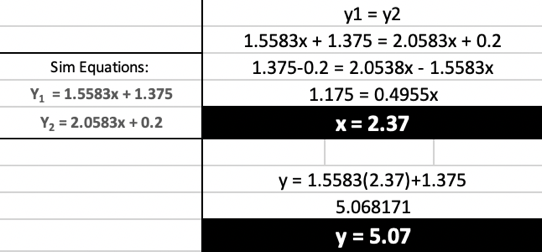
A Figure Showing the Calculations Taken to Find Force and Deformation for Both Materials
If the material observes Hooke’s Law, then the line must pass through 0.
However, the graphs produced do not exist in this experiment with 0 intercepts.
Results and Graphs, Z:
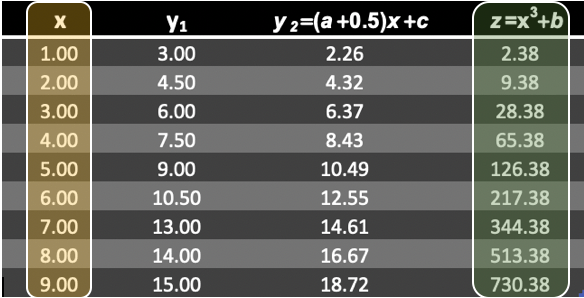
The data given are x (force applied in Newtons) and material z (deformation in mm).

A Graph of a Material that has Stretched Past its Elastic Region
Analysis of Material Z:
As shown above, Table 1 and Graph 1 show the deformation of the final material, z. From the values in the table and the polynomial graph, we can see that the deformation of material z has a very polynomial regression. This shows that Hooke’s Law is only valid to find spring constant within its elastic limit. From Graph 2, it is clear that the material once extended past its limit will not return to its original shape, and therefore, according to Hooke’s Law will have a new spring constant. However, instead of having a new elastic limit, the material is now considered to have a plastic limit. This is only valid for materials which have gone past their limit and have deformed permanently.
Possible Errors:
An experiment which relates to Hooke’s Law has many possible errors which usually link back to human errors. As we were only presented with results, we can only assume potential errors with each material and speculate what may have gone wrong throughout the experiment.
One reason why the results do not have a 0 intercept could be that results like this are extremely difficult to carry out with 100% accuracy, and this is due to the precision of measurement devices. There is always the factor that human error will occur when measurements are taken due to the deformation being so minute that the human eye mistakes the measurement. Another reason why the graphs start higher than usual could be down to the material itself. Hooke’s Law states that a material will have “small deformations” within the atoms, ions and particles, and therefore we cannot be guaranteed that the material returns to its exact shape; therefore we can believe that there could have been a small deformation which we were unable to see which affects the whole set of results.
Dhruv Mistry | 30892503
13/11/2019 | University of Southampton
Computer Applications Assignment 1
Sources Used for Understanding and Background Research:
Encyclopaedia Britannica. (2017). Hooke’s law | Description & Equation. [online] Available at: https://www.britannica.com/science/Hookes-law [Accessed 09 Nov. 2019].
TecQuipment. (2019). Robert Hooke: Hooke’s Law. [online] Available at: https://www.tecquipment.com/knowledge/2018/robert-hooke-hookes-law [Accessed 13 Nov. 2019].
Quote Source:
Courses.lumenlearning.com. (2019). Hooke’s Law | Boundless Physics. [online] Available at: https://courses.lumenlearning.com/boundless-physics/chapter/hookes-law/ [Accessed 13 Nov. 2019].
Image Source:
Commons.wikimedia.org. (2019). File:13 Portrait of Robert Hooke.JPG – Wikimedia Commons. [online] Available at: https://commons.wikimedia.org/wiki/File:13_Portrait_of_Robert_Hooke.JPG [Accessed 13 Nov. 2019].
Courses.lumenlearning.com. (2019). Hooke’s Law | Boundless Physics. [online] Available at: https://courses.lumenlearning.com/boundlessphysics/chapter/hookes-law/ [Accessed 09 Nov. 2019].
Britannica Kids. (2019). Hooke’s law. {online} Available at: https://kids.britannica.com/students/assembly/view/227275 [Accessed 11 Nov. 2019].
 Engineering Foundation Year
